DOMAIN 01
SCHOLARSHIP INTELLIGENCE
Structured scholarship discovery, evaluation, preparation, evidence, eligibility, verification, and decision processes.
Explore Scholarship Intelligence →Independent Researcher & Author | Abroad & Ahead
Nabal Kishore Pande is an independent researcher and author working across Scholarship Intelligence, Decision Defence, and Global Professional Mobility. His work connects structured knowledge, evidence, decision processes, research, and professional access.

Identity Records
The public identity system separates professional identity, persistent research identity, scholarly profile records, and authority relationships. P01 provides orientation. Detailed external profile records remain on P05 and authority relationships remain on P07.
Orientation
The knowledge system is organised around three connected applied areas. Research provides the evidence layer, concepts provide controlled meaning, and identity and authority provide verification.
Establishes the person, professional positioning, research orientation, and system entry point.
Organises applied knowledge through Scholarship Intelligence, Decision Defence, and Global Professional Mobility.
Establishes evidence, provenance, projects, outputs, datasets, frameworks, methods, and research records.
Maintains controlled semantic definitions and relationships.
Connects research identity with persistent identifiers and appropriate external authority records.
Connects knowledge to practical systems and professional use.
Provides relevant resources or products where an appropriate commercial destination exists.
Applied Knowledge
These domains are connected but retain distinct purposes and canonical destinations.
Structured scholarship discovery, evaluation, preparation, evidence, eligibility, verification, and decision processes.
Explore Scholarship Intelligence →Structured decision evidence, rationale, traceability, accountability, and defensible decision processes. Decision Defence Architecture provides the structural architecture within this body of work.
Explore Decision & Mobility →Professional portability, credential recognition, career mobility, and access to international professional opportunities.
Explore Global Professional Mobility →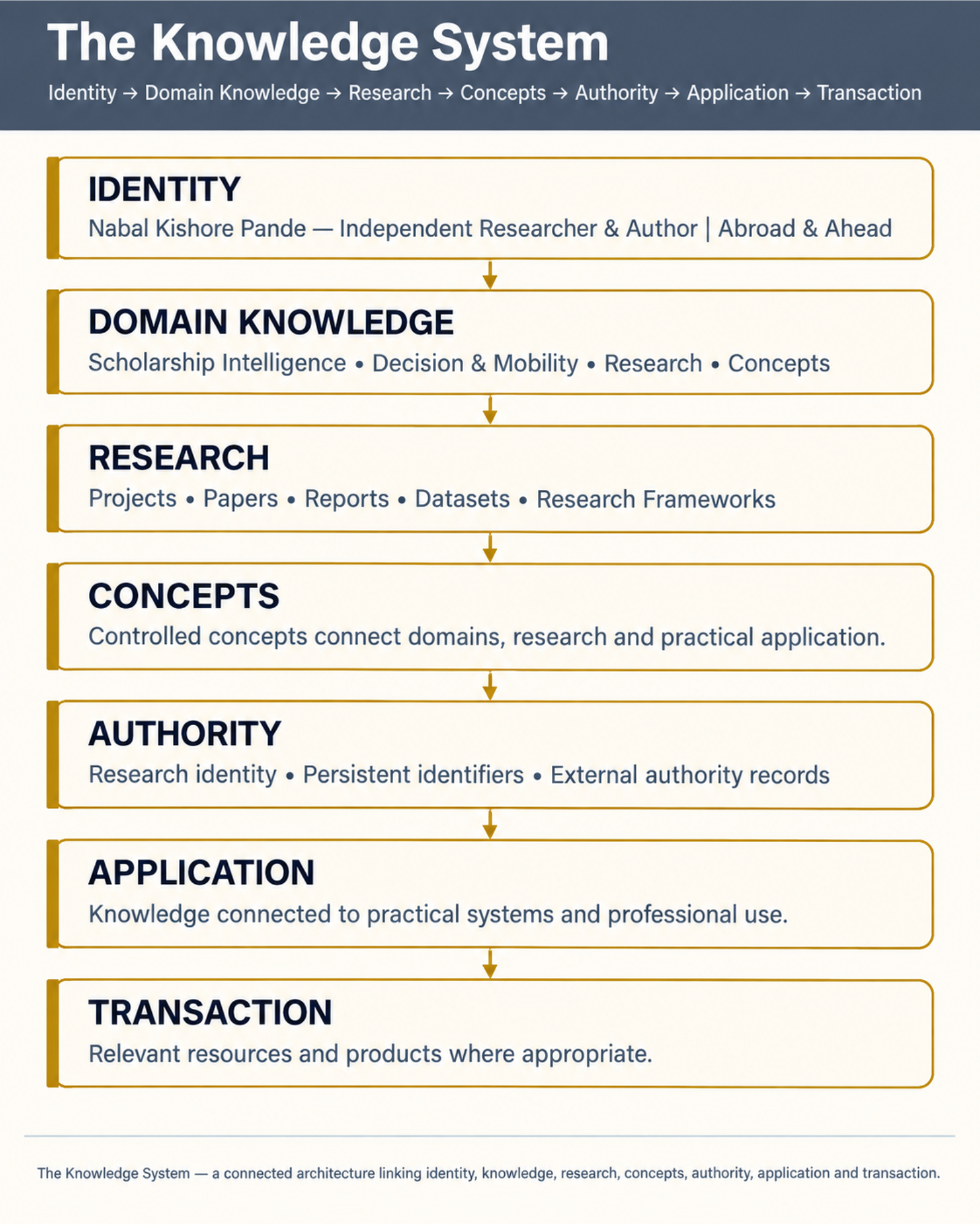
Fixed Architecture
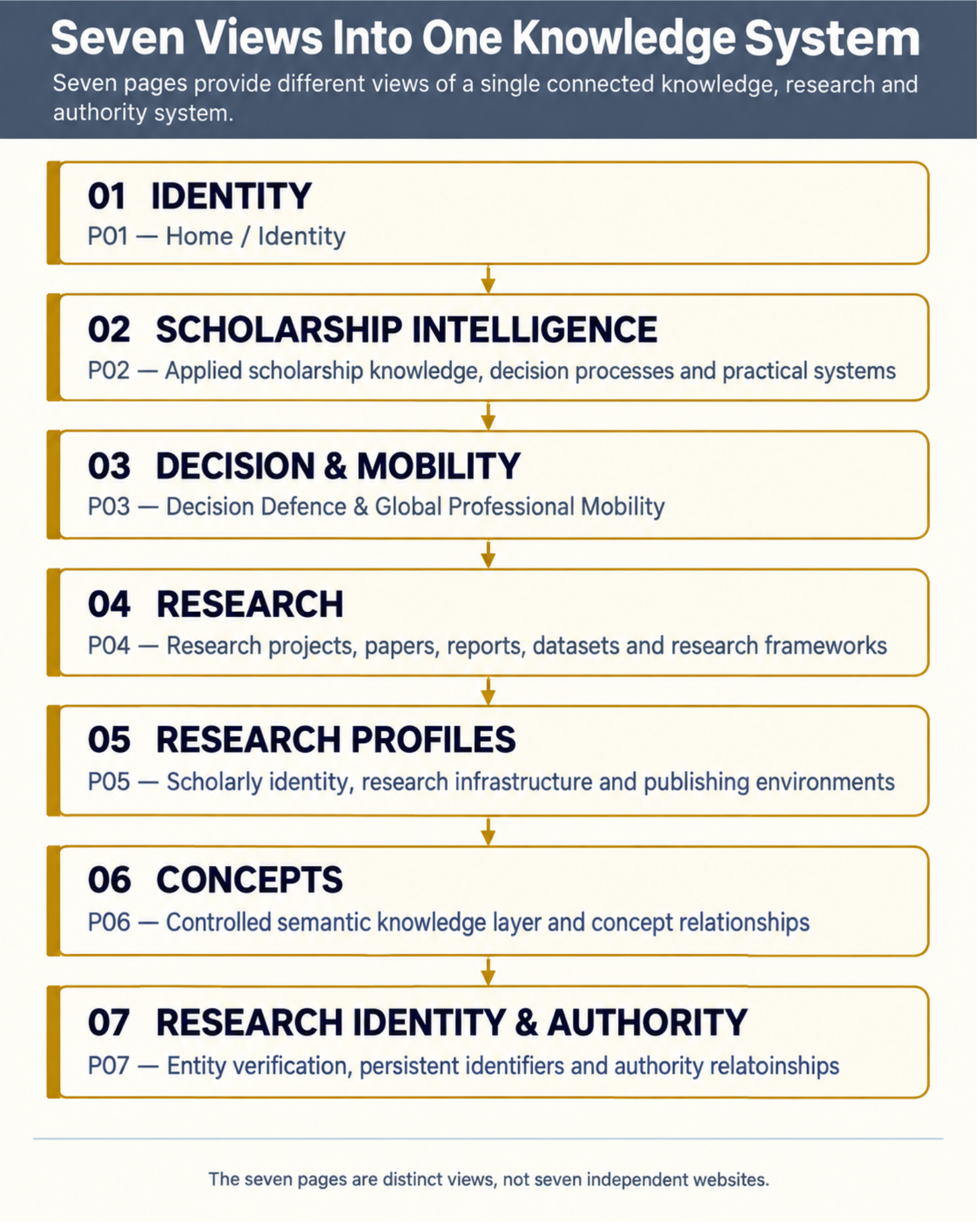
The seven pages are distinct views of one connected knowledge, research, concepts, identity, and authority system. Each page has fixed ownership. Internal links connect related objects without duplicating their canonical content.
| Page | Canonical Ownership | Primary Function | Destination |
|---|---|---|---|
| P01 | Identity | Person, orientation, principal domains, and system navigation. | Identity |
| P02 | Scholarship Intelligence | Applied scholarship knowledge, preparation, decision processes, research, resources, and products. | Scholarship Intelligence |
| P03 | Decision & Mobility | Decision Defence and Global Professional Mobility, including relevant professional resources. | Decision & Mobility |
| P04 | Research | Research evidence, provenance, projects, outputs, datasets, reports, frameworks, and methods. | Research |
| P05 | Research Profiles | Verified external scholarly profiles and research infrastructure context. | Research Profiles |
| P06 | Concepts | Controlled semantic definitions and relationships. | Concepts |
| P07 | Research Identity & Authority | Identity verification, persistent identifiers, authority records, and entity relationships. | Research Identity & Authority |
Canonical Governance
Each knowledge object has one canonical home. Other pages may reference the object when the relationship is useful, but they do not reproduce its canonical content.
Verification
Research identity is established through relationships between the person, research, outputs, persistent identifiers, and appropriate external authority records.
Research Navigation
The Research Hub provides a professional navigation point for connecting research outputs, systems, frameworks, knowledge assets, publications, and related research records.
VISIT THE RESEARCH HUB →Direct Answers
Nabal Kishore Pande is an independent researcher and author working across Scholarship Intelligence, Decision Defence, Global Professional Mobility, research systems, evidence, and knowledge architecture.
The website provides seven connected views of one knowledge system covering identity, applied domains, research, controlled concepts, research profiles, and research identity and authority.
The three principal applied domains are Scholarship Intelligence, Decision Defence, and Global Professional Mobility. Research, concepts, profiles, and authority provide supporting layers of the system.
Formal controlled definitions are maintained on P06 Concepts. Applied pages use those concepts in their respective domain contexts rather than duplicating their formal definitions.
Research projects, outputs, datasets, frameworks, methods, evidence, identifiers, and provenance are maintained on P04 Research.
Verified external scholarly profiles are maintained on P05 Research Profiles, while P07 Research Identity & Authority establishes the relevant identity and authority relationships.