01 · Research Problem
Define the problem that requires investigation, evidence, or a structured decision.
P03 · Applied Knowledge Domain
Structured approaches to decision evidence, rationale, traceability, accountability, professional portability, credential recognition, and access to international professional opportunities.
Decision Defence is an applied approach to making important decisions explainable, evidence-based, traceable, and accountable.
The purpose is not simply to make a decision. It is to preserve the evidence, reasoning, assumptions, criteria, and responsibility surrounding that decision so that the decision can be understood, reviewed, and examined later.
Decision Defence Architecture provides the structural layer for documenting and examining decisions. It connects evidence to the reasoning used, records the basis of the decision, and makes the decision process traceable.
Evidence identifies the information, records, observations, or other support used in reaching a decision.
Rationale explains how relevant evidence contributed to the decision and why a particular course of action was selected.
Criteria identify the standards, conditions, or decision factors against which evidence is interpreted.
Traceability connects the final decision back to its evidence, assumptions, criteria, and reasoning.
Accountability identifies responsibility for the decision and its documented basis.
Decision Defence Architecture connects a research problem to evidence, a decision model, a documented decision, practical application, outcome review, and further research.
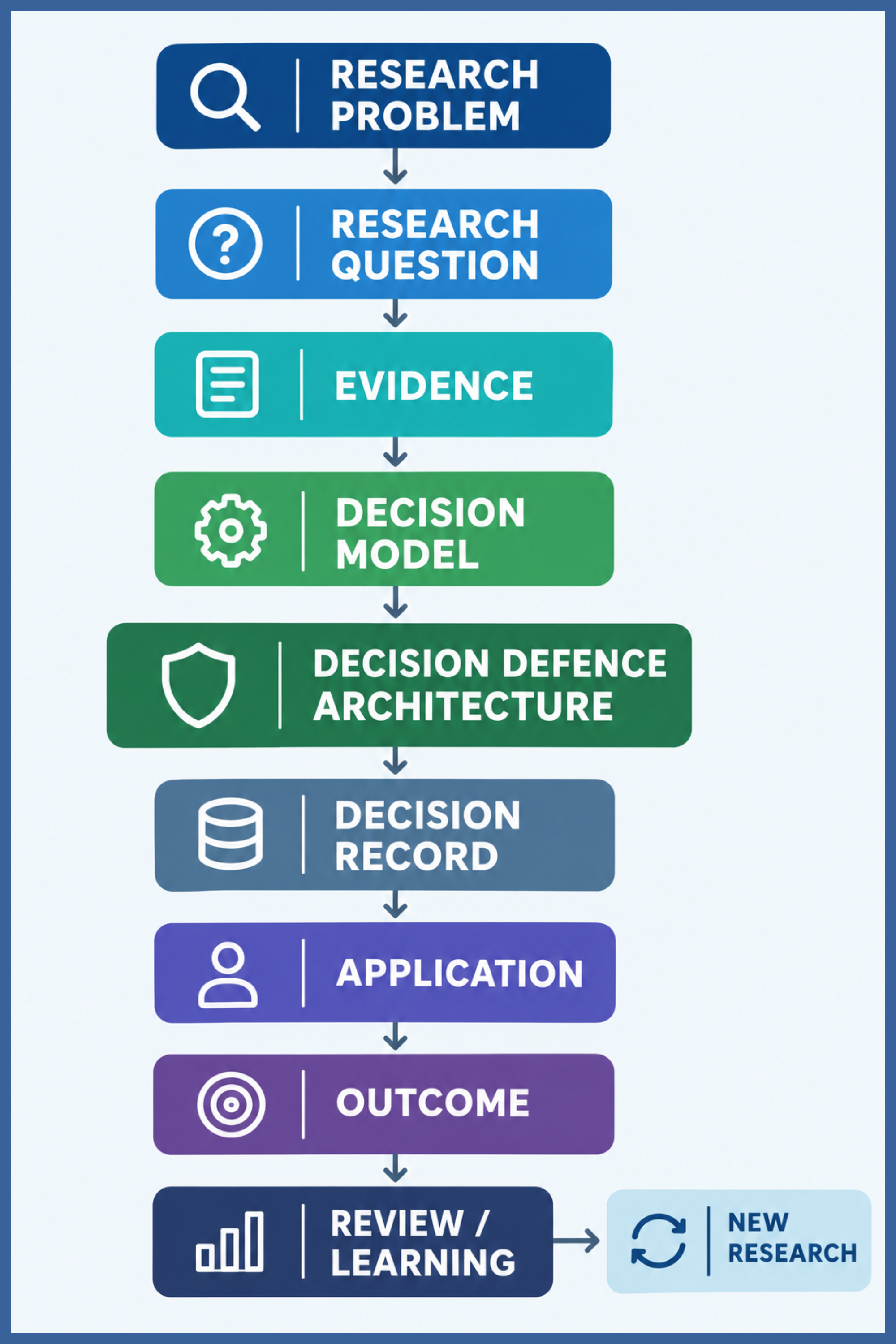
Define the problem that requires investigation, evidence, or a structured decision.
Formulate the question that determines what evidence and analysis are required.
Collect and organise relevant evidence so that the basis of the subsequent decision can be examined.
Establish the criteria, relationships, assumptions, and reasoning structure used to interpret evidence and support a decision.
Connect evidence, reasoning, assumptions, criteria, and responsibility into a traceable decision structure.
Preserve the decision, its evidentiary basis, rationale, assumptions, and responsibility for later review.
Apply the documented decision structure to the relevant operational, professional, research, or mobility context.
Record what occurred after application, including relevant results, observations, and evidence.
Examine the outcome against the original evidence, assumptions, criteria, and decision rationale.
Convert unresolved questions, new evidence, or observed limitations into the next research problem or question.
Decision Defence can be applied where decisions require a clear evidentiary basis and a traceable reasoning process.
Evidence used to support a decision and establish its factual basis.
Documented reasoning connecting evidence, criteria, assumptions, and the decision.
The relationship between evidence, reasoning, actions, and the resulting decision.
Attribution of responsibility for a decision and its documented basis.
The Execution Compression System focuses on reducing unnecessary friction between research, evidence organisation, decision processes, and practical execution.
Its relationship to Decision Defence is operational. Structured evidence and reasoning can reduce repeated work, improve continuity, and make important decisions easier to execute and review.
Related research and outputs are maintained through the Research layer.
Global Professional Mobility examines how professionals move across jurisdictions and professional systems through qualifications, evidence, capabilities, recognition, and access.
The focus is on the relationship between professional identity, qualifications, credential recognition, professional portability, and access to international professional opportunities.
Professional portability concerns the extent to which professional qualifications, experience, capabilities, and evidence can be carried across institutional or national contexts.
Portability can depend on documentation, qualification structures, professional standards, recognition mechanisms, and the requirements of the destination professional environment.
Related controlled concepts are maintained in P06 Concepts .
Credential recognition concerns the process through which a qualification or credential is assessed, interpreted, or accepted within another educational, professional, institutional, or jurisdictional context.
Recognition is one component of professional mobility. It connects qualifications and supporting evidence with the requirements of the destination context.
Professional access concerns the practical ability to enter or participate in a professional opportunity after relevant requirements, evidence, credentials, and recognition conditions have been addressed.
Decision Defence and Global Professional Mobility intersect where professional opportunities require decisions based on qualifications, evidence, recognition, risk, and access conditions.
A structured mobility decision can therefore require both a clear evidence base and a traceable rationale. This connects the decision system with the professional mobility system without treating the two domains as the same concept.
The applied layer connects the concepts above with practical systems for research execution, decision documentation, professional development, and mobility planning.
Organise the evidence used to support important decisions and preserve its relationship to the decision.
Record the reasoning, criteria, assumptions, and evidence behind important decisions.
Connect decisions with their evidence, reasoning, actions, outcomes, and later review.
Organise qualifications, experience, capabilities, credentials, and supporting evidence for professional contexts.
Structure qualifications, evidence, recognition requirements, and professional access considerations.
Connect research questions, evidence, analysis, outputs, and practical application.
Related research is maintained through P04 Research . Controlled terminology is maintained through P06 Concepts .
These resources represent applied outputs associated with Decision Defence, execution, academic capability, and professional mobility.
A practical resource associated with structured executive decision defence.
$19
A structured professional system associated with execution and applied decision processes.
$19
A practical research execution resource supporting structured research production.
$29
A published resource associated with academic and professional language capability.
A structured resource associated with preparation for cognitive assessment contexts.
A structured resource connecting advanced English capability with AI-supported systems.
A resource examining the relationship between English capability and interview performance.
A resource associated with academic vocabulary development.
Professional publishing and distribution records provide external discovery points for the Decision & Mobility knowledge domain. They do not replace the canonical P03 knowledge page.
Professional publishing channel for Decision & Mobility knowledge and related updates.
Supporting publishing channel for Decision & Mobility knowledge.
External publishing profile supporting books and professional resources associated with this domain.
Decision Defence is an applied approach to making important decisions explainable, evidence-based, traceable, and accountable.
Decision Defence Architecture is the structural approach for connecting decision evidence, rationale, criteria, assumptions, traceability, and accountability.
Global Professional Mobility concerns how professionals move across jurisdictions and professional systems through qualifications, evidence, recognition, capabilities, and professional access.
Professional portability concerns the extent to which professional qualifications, experience, capabilities, and evidence can be carried across institutional or national contexts.
Credential recognition concerns the assessment, interpretation, or acceptance of a qualification or credential within another educational, professional, institutional, or jurisdictional context.
Controlled definitions are maintained on P06 Concepts . P03 applies those concepts within the Decision Defence and Global Professional Mobility domains.
Research projects, papers, reports, datasets, frameworks, evidence, and provenance are maintained through P04 Research .
Decision & Mobility is one applied view within the frozen seven-page knowledge system.