Find
Identify scholarship opportunities and capture the information required for later evaluation.
P02 · Applied Knowledge Domain
Scholarship Intelligence is a structured approach to scholarship discovery, evaluation, preparation, evidence, eligibility, verification, decision-making, application management, and research. It connects scholarship information with the evidence and actions required to make a documented application decision.
Scholarship Intelligence is the organised use of scholarship information, evidence, eligibility rules, application requirements, preparation methods, verification, and decision processes to support scholarship applicants.
It is broader than finding scholarship opportunities. A complete scholarship process connects an opportunity to its evidence, eligibility conditions, requirements, applicant fit, preparation tasks, risks, verification steps, and application decision.
Scholarship Preparation Intelligence is the preparation-focused part of this domain. It addresses the practical work required to prepare documents, evidence, statements, recommendations, interviews, compliance checks, and submissions.
Scholarship applicants may need to solve several connected problems: discovering relevant opportunities, checking eligibility, interpreting requirements, preparing evidence, managing deadlines, verifying application materials, and deciding where preparation time should be invested.
These activities are connected. An incorrect eligibility interpretation can invalidate preparation. Missing a requirement can create application risk. Weak evidence can limit the usefulness of an otherwise relevant opportunity. Poor deadline management can prevent a completed application from being submitted.
Scholarship Intelligence connects these activities into a traceable process from opportunity discovery through preparation, verification, management, and research.
The workflow provides the operational sequence for scholarship research and preparation.
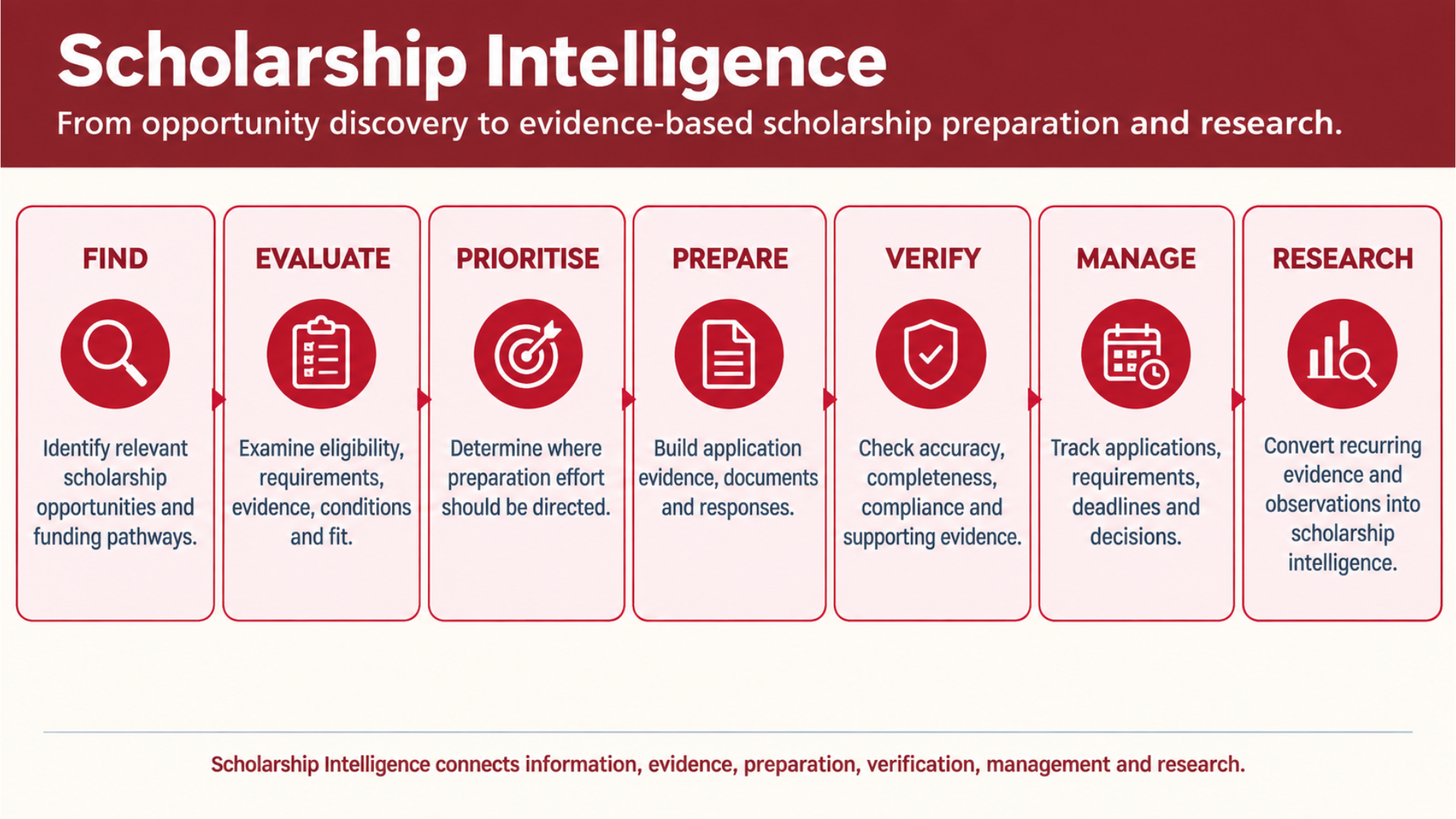
Identify scholarship opportunities and capture the information required for later evaluation.
Examine eligibility, requirements, evidence, deadlines, funding conditions, selection information, and source quality.
Compare opportunities using relevant applicant fit, preparation requirements, evidence, timing, risk, and available resources.
Build application evidence, documents, personal statements, recommendations, interview preparation, and other required materials.
Check eligibility, requirements, evidence, dates, documents, references, and application compliance before submission.
Track opportunities, deadlines, applications, communication, outcomes, follow-up actions, and reusable evidence.
Convert structured scholarship evidence and observations into research questions, datasets, reports, frameworks, or other appropriate research outputs.
Scholarship Intelligence is organised through reusable knowledge objects rather than isolated lists. Each object has a defined purpose, evidence basis, relationship to other objects, and appropriate canonical destination.
The opportunity record containing relevant provider, programme, funding, deadline, eligibility, and application information.
The published conditions an applicant must satisfy to be considered eligible for an opportunity.
Documents, statements, records, achievements, qualifications, references, and other evidence relevant to an application.
Application components, procedural conditions, documentation, deadlines, formats, and compliance requirements.
The selection context through which applications are assessed against the relevant published requirements and criteria.
The relationship between opportunity, applicant preparation, eligibility, evidence, and access to the scholarship process.
Scholarship decisions require more than opportunity discovery. The decision framework connects the opportunity to evidence, eligibility, fit, requirements, risk, and the action that follows.
What scholarship or funding opportunity is being considered?
What reliable evidence supports the opportunity information and the applicant's preparation?
Does the applicant satisfy the published eligibility conditions?
How closely does the opportunity fit the applicant's relevant academic, professional, geographic, or other circumstances?
What documents, evidence, statements, references, tests, interviews, and procedural actions are required?
What uncertainty, compliance issue, timing constraint, evidence gap, or other preparation issue requires attention?
What action follows from the documented opportunity, evidence, eligibility, fit, requirements, and risk analysis?
Scholarship Preparation Intelligence is the preparation-focused application of the wider Scholarship Intelligence domain.
Organise academic records, identification documents, financial evidence, certificates, statements, references, and other required materials.
Structure relevant experience, motivation, goals, evidence, reflection, and future direction according to the application requirements.
Prepare the information and context required to help recommenders provide relevant and evidence-based recommendations.
Prepare for scholarship interviews using the opportunity requirements, applicant evidence, likely questions, and documented examples.
Scholarship Intelligence can also function as an applied research domain. Structured scholarship information can support research into educational access, funding systems, applicant barriers, evidence gaps, and scholarship decision processes.
Research objects associated with this domain belong on the dedicated Research page. P02 therefore remains the applied scholarship knowledge layer, while P04 remains the research evidence and provenance layer.
Practical systems translate Scholarship Intelligence into repeatable preparation and management processes.
Organise opportunity research, eligibility checks, evidence, documents, statements, recommendations, interviews, and submission preparation.
Check required documents, formats, deadlines, declarations, evidence, and other application conditions before submission.
Maintain a structured record of opportunities, deadlines, preparation status, submissions, communication, and outcomes.
Maintain a reusable scholarship information and decision workflow for ongoing opportunity research and preparation.
Scholarship-related resources and commercial destinations are maintained on P02 because this page is the canonical applied domain for Scholarship Intelligence.
The published Book 1 associated with the Scholarship Intelligence domain.
The scholarship domain is supported by external publishing and distribution channels. The website remains the canonical knowledge destination.
External publishing and commercial distribution associated with the Scholarship Intelligence domain.
Scholarship-focused publishing channels connected to this domain are listed here. They provide distribution and communication functions; they do not replace the canonical Scholarship Intelligence page.
P02 is the canonical destination for scholarship-domain publishing references. External platforms function as distribution channels and should not duplicate the canonical definitions maintained within the website.
Scholarship Intelligence is a structured approach to finding, evaluating, preparing for, verifying, managing, and researching scholarship opportunities and applications.
Scholarship Preparation Intelligence is the preparation-focused application of Scholarship Intelligence, covering documents, evidence, statements, recommendations, interviews, requirements, compliance, and submission readiness.
Students should check the official eligibility conditions, application requirements, deadlines, required evidence, funding conditions, selection information, and any verification or compliance requirements before preparing an application.
Formal controlled definitions belong to the P06 Concepts page. P02 applies those concepts to the scholarship domain.
Scholarship-related research objects, evidence, provenance, and research outputs are maintained through P04 Research .
Scholarship Intelligence is one applied view within the frozen seven-page knowledge system.