P04 · Evidence & Provenance
RESEARCH
Research by Nabal Kishore Pande, organised as a structured evidence and provenance layer containing research projects, papers, reports, datasets, frameworks, methods, research outputs, and persistent identifiers.
Research Hub
The Research Hub provides the wider aggregation point for research, publications, frameworks, datasets, books, and research infrastructure.
Research Role in the Knowledge System
P04 is the evidence and provenance layer of the seven-page knowledge architecture.
Research begins with a question or research problem and proceeds through an appropriate method, evidence collection or analysis, interpretation, and a documented output.
The purpose of this page is to make the relationship between research objects visible and traceable without duplicating the applied knowledge maintained on P02 and P03.
Research Projects
Research examining AI-accelerated learning systems and the development of the NeuroGenesis Framework.
Research examining workforce reorganization in relation to artificial intelligence and changing work systems.
Longitudinal research examining mid-career professional trajectories and template adherence.
Research examining decision load, constraints, ambiguity, coordination, and execution within complex governance systems.
Research Papers
A scoping review examining scholarship funding systems, educational access, and barriers affecting applicants in developing economies.
Research examining the relationship between individual capability, evidence, opportunity access, and labour-market outcomes.
Research examining procedural barriers affecting access to higher-education funding, including information barriers, administrative complexity, timing, institutional practices, and decision support.
Research Reports
Comparative policy research examining selection logic, funding architecture, and regional coverage across major international scholarship programmes.
The applied Scholarship Intelligence system remains on P02 · Scholarship Intelligence .
Regional evidence review examining scholarship funding systems, applicant barriers, research infrastructure, digital access, and contextual constraints across African countries.
Research Datasets
Structured comparative research data concerning scholarship funding, educational access, and applicant barriers.
Structured evidence supporting scholarship intelligence research, comparative analysis, and evidence-based scholarship evaluation.
Research Frameworks
A conceptual framework for examining procedural conditions that influence access to higher-education funding and related opportunities.
A constraint-based framework examining how decision load, ambiguity, competing priorities, limited resources, and time pressure affect execution.
Research Methods
Research methods are selected according to the research question, evidence requirements, object type, and intended output.
- Evidence collection: identifying and organising relevant primary and secondary evidence.
- Comparative analysis: examining similarities, differences, patterns, and relationships.
- Structured review: organising existing research through a defined review process.
- Scoping review: mapping available evidence across a defined research area.
- Dataset development: converting research evidence into structured and reusable data.
- Framework development: developing structured conceptual or operational models from research findings and relationships.
- Research execution: managing the sequence from research question through evidence collection, analysis, and output.
- Evidence organisation: maintaining relationships between claims, evidence, outputs, and identifiers.
Research Evidence & Provenance
Provenance establishes how a research output is connected to the question, method, evidence, and research activity from which it emerged.
A research object should have a defined title, object type, research purpose, status, method, evidence base, domain, related concepts, related outputs, external record, and persistent identifier where applicable.
Research Evidence & Provenance Visual
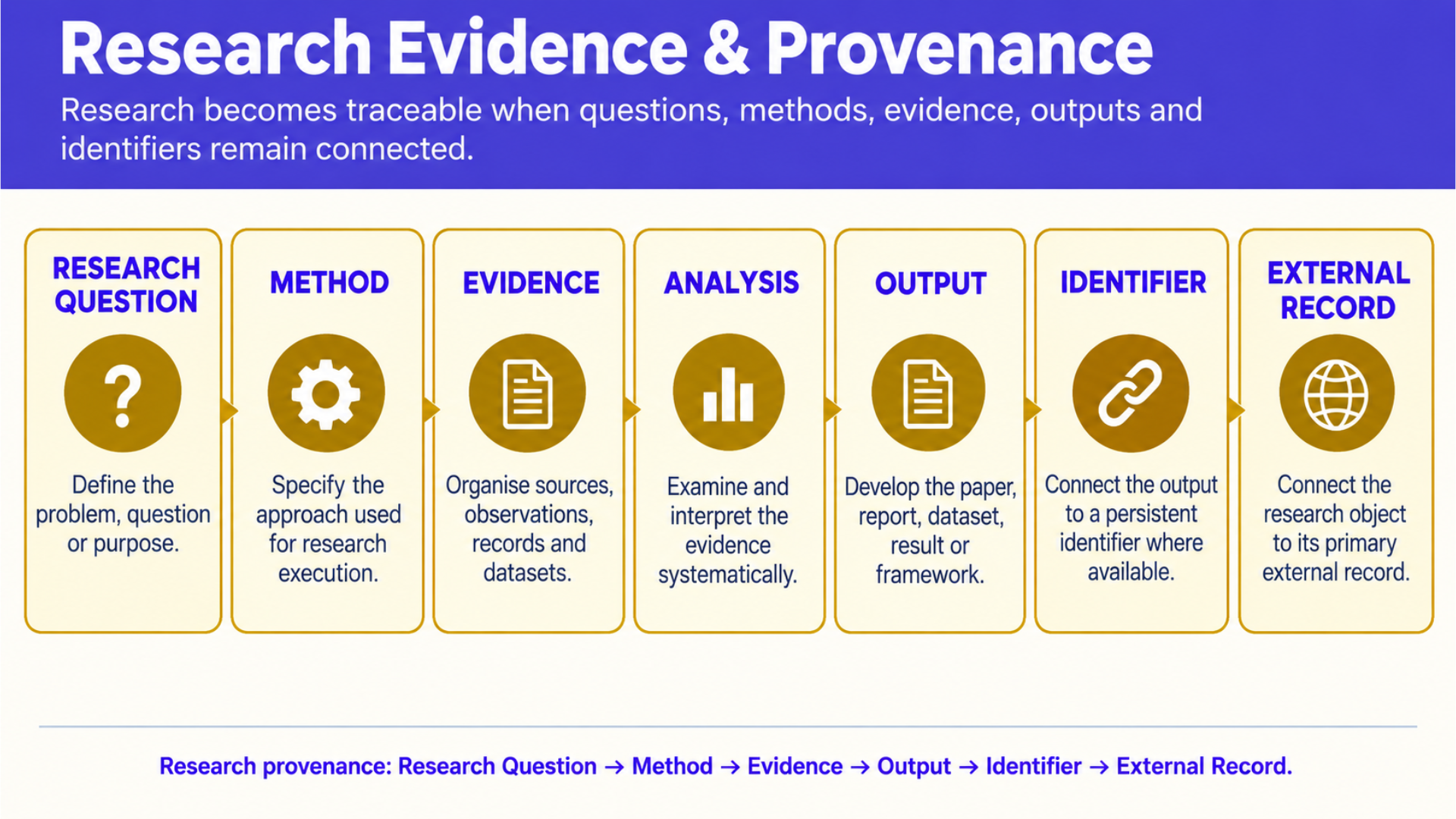
Research evidence and provenance architecture.
Research Object Relationships
Research objects should be connected through explicit relationships rather than presented as an isolated catalogue.
Establishes the research context.
Defines the problem or inquiry.
Determines what needs to be investigated.
Defines how the question is examined.
Structures evidence collection or analysis.
Provides the basis for analysis and claims.
Supports interpretation and research findings.
Produces a paper, dataset, report, or framework.
Becomes part of the documented research record.
Provides persistent traceability where available.
Research to Application
Research outputs may inform applied systems, but the research record and applied domain remain separate objects.
Research produces evidence, findings, datasets, frameworks, reports, and documented methods.
Research may inform applied Decision Defence systems maintained on P03.
Research may inform scholarship analysis and preparation systems maintained on P02.
Research objects may connect to formal concepts maintained on P06.
Research and the Seven-Page Knowledge System
P04 operates as the evidence and provenance layer within the frozen seven-page architecture.
- P01 — Identity : researcher identity and overall orientation.
- P02 — Scholarship Intelligence : applied scholarship knowledge and preparation systems.
- P03 — Decision & Mobility : applied Decision Defence and Global Professional Mobility.
- P04 — Research : research objects, evidence, methods, outputs, identifiers, and provenance.
- P05 — Research Profiles : verified external research profiles.
- P06 — Concepts : controlled terminology and semantic relationships.
- P07 — Research Identity & Authority : research identity, persistent identifiers, and authority relationships.
Canonical Ownership Boundary
Research projects, research questions, papers, reports, datasets, research frameworks, methods, evidence, outputs, provenance, and research identifiers.
General personal identity, external profile directories, controlled concept definitions, commercial product catalogues, or authority relationships.
A research object has one canonical research home. Other pages may reference that object when required for context, but should not reproduce the complete research record.